



Early in this project I wrote about the idea of unseeableness. It’s the moment where the dots connect (always and only in reverse) and you can suddenly see the forest and the trees. You can now paint a fair picture of the macro while still understanding the important details at the micro. This is a Julia-Child-crying-over-a-pastry moment because it feels so deliciously perfect, and rare.
If you know the way broadly, you will see it in all things. - Miyamoto Musashi
That’s how I feel right now with our Birthrate and Borders project. I don’t know how long it will go, but it will go until it’s all used up, because there is so much juice to squeeze. I’m not the first to write in detail about it (of course), but it doesn’t yet seem to be in the mainstream zeitgeist and that is unsettling somehow. Perhaps more accurately, we’re all unsettled by it and so it becomes complicated to talk about in public.
This occurred to me when doing the research for Issue #55 - re-cracking the spine of Ray Dalio’s The Changing World Order1. Of all of the determinants of Dalio’s Big Cycle, birthrate isn’t one of them. Perhaps it would have been if we all weren’t so surprised by how fast the problem came to be.
The problem is big. It’s really big. That means it also presents a compelling opportunity and we need to get it as right as possible, together.
I live in a region of the world that is experiencing the Birthrate and Borders conundrum more acutely than almost anywhere else. Obviously I’m not discounting or what’s happening in regions that are experiencing true suffering like wars or famine, but my home is exactly the archetype of a place that would be experiencing the problem acutely. And like any good healthcare provider will tell you - best not to let the acute become chronic.
My family is one of the many mixed-lineage family lines of Atlantic Canada. My maternal line from New Brunswick - a bilingual, socio-economic extension of New England, and my paternal line from Random Island, Newfoundland - tucked in to the cove of a stunning archipelago whose eastern flank is Ireland’s Eye, so named because if you were to accidentally paddle your kayak into the North Atlantic Drift, your next port of call would be Galway, whether you like it or not.
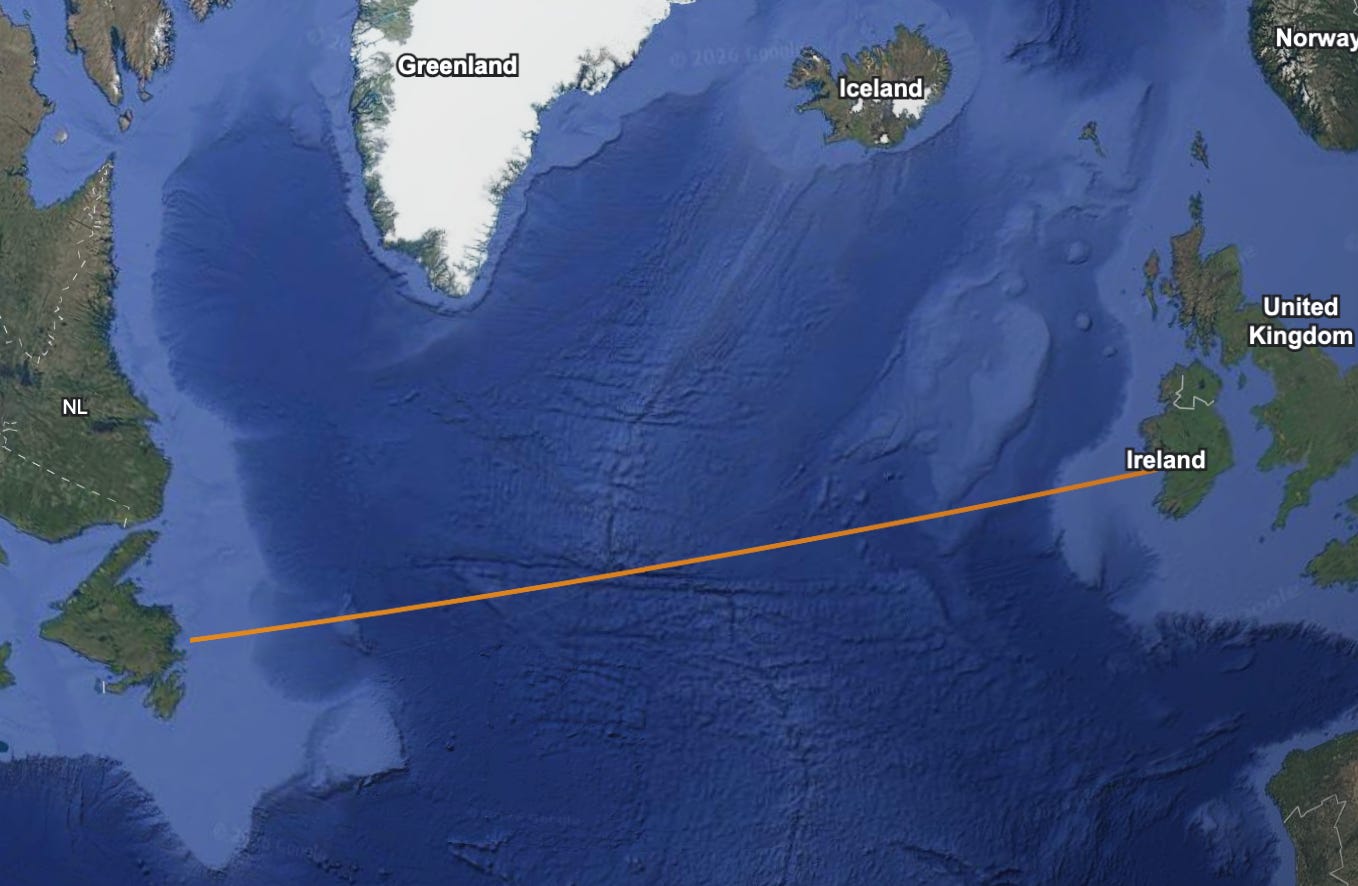
I’ve argued before that it is easy to see your long history when you come from the sea coast because your long-lost-lover (the opposite coast) is not far across the ocean and you were once part of the same whole. The cod fishermen in Newfoundland, and their Basque brethren are so intimately linked that they bicker about who first established a commercial cod fishery2.
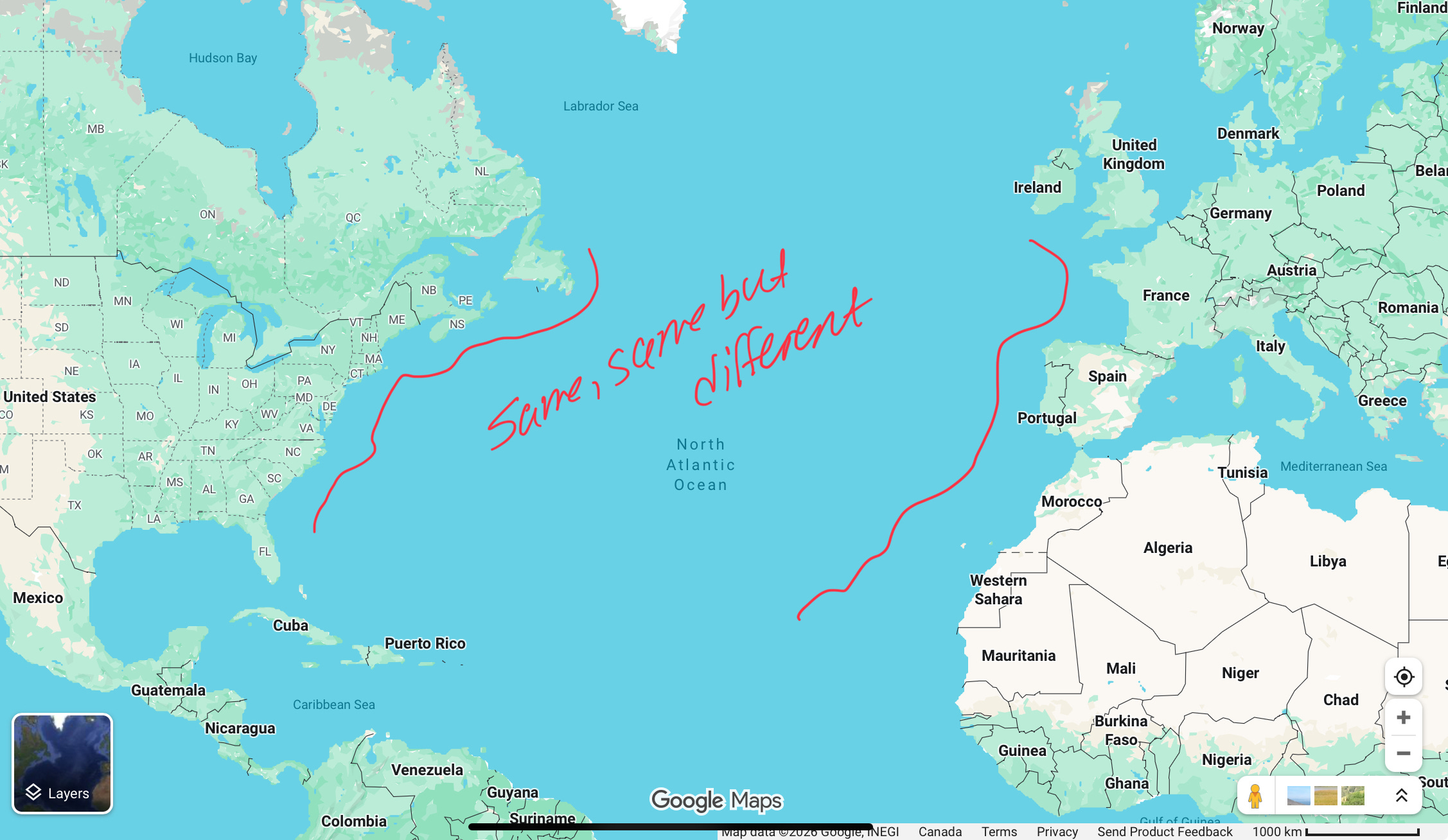
But it isn’t our long history that tells the story of daily life for the average person. In your long history you can see the macro story of your place and it’s people - what Chris Arnade calls thick culture. And in daily life you can see the details - thin culture.
As surface level as thin culture often is, both are important for economic development because the core of it is simply how daily life works for the average person, on an average day, in an average place. You might call that micro-development or community development and it is a process that you can literally see. Macro economics, on the other hand, is largely voodoo and it’s astounding how wrong you can be, consistently, over time while still being a respected economist.
I remember the day this crystallized for me. I was spending the month of August in my father’s hometown and needed to rent a car. There was an Enterprise nearby and so I walked down to see about doing the deed. I was met with an absurdly friendly worker - far from uncommon in a place where trust, kindness, and warmth are key pillars of the culture. Let’s call her Donna.
Donna was the kind of person that makes me question whether I am actually a good person or not. She was so positive and wonderful that I felt bad about myself. Could I ever be this good working at a rental car agency? Where my life would be defined by routine and my immediate surroundings? Why do I know that I wouldn’t be - couldn’t be - and why does that make me in awe of Donna?
I instinctively knew everything I needed to know about Donna and her daily life. I knew it was centred around human relationship - her family and her community - not abstract ideas of ‘productivity’. I knew what was on the dinner table that night - could practically smell it - and I knew where she would be that Friday evening, and on Sunday morning. I could guess what her husband did for a living, and I knew where her kids went to school. I knew that she was the focal point of the family - she ran the ship - and she ran it damn well mind you!
I knew this because of a combination of thick and thin culture, and because I am of that place. That’s how I also knew how much change was going to come to my small slice of the world, and then - eventually - to every single slice of the world there is.
Issue #55 will dig in to how money and people move together in cycles. Why debt and money are the other growth problems, and why they are important pieces of the birthrate and borders puzzle. History doesn’t repeat itself, but it sure does rhyme.
Let’s dig in.
The only things that change are the clothes the characters are wearing, the languages they are speaking, and the technologies they’re using. - Ray Dalio
People, Place, Time, and Money - The Big Cycle
Leaving Donna, rental agreement signed, in pursuit of a day spent driving the mid-Eastern coast of my ancestral homeland, I felt a sense of:
Oh, I see what’s happening here - people and places move at different speeds through time. We’re on the same planet, but we’re on different time.
Productivity…driven by learning, building, and inventiveness - has steadily improved over time. However, it has risen at different times for different people, though always for the same reasons… - Dalio


I recalled the feeling of Bigness of East Africa, the feeling of Pre-History of the Greek islands, the Global Machine of New York City, imagined what I’ve been told can only be described as The Future of nation-states like Singapore (I haven’t yet had the pleasure), and I felt the feeling of my Atlantic home that was clearly somewhere in the middle.
The middle, though, is full of contradictions, especially as more time passes. Canada is an important member of the G7, and is a huge country with relatively few people in it, concentrated in major corridors, of which my home is not one of them. The population is leaving and aging rapidly, and to stave off the coming age-wave (and the unavoidable obligations it brings with it3) the country and it’s provinces continue to implement growth strategies - mostly immigration based.
The growth and productivity story can’t be ignored here because money and people move through systems in tandem, not in isolation. Those who leave home don’t do so because they want to, they do so because of a perception of having to. This isn’t all or nothing - some do leave with a spirit of adventure and experience in their hearts, and that’s perfectly human too. We are the Seeker Species and so we go and do that. But talk to any of your friends in the immigrant community and you’ll quickly realize economic opportunity is 1A.
At the people and birthrate level, the crux of the money problem includes cost of living and household debt (immediate and obvious), and it also includes things like community banking and urbanization (less obvious).
In the former category, cost of living makes it hard to plan for the long-term, and unmanageable debt leads to fear-based decisions. I was surprised to what degree until Dr. Dhirendra Shukla told us on a podcast panel that one of the first things he would do to help increase the rate of entrepreneurship in our region is lower the student debt burden. I was surprised at the time but it makes sense - graduating with a debt load that feels unmanageable clouds your judgement and decision making at a time when you are otherwise the most able and willing to take risk4.
The latter category is less obvious but is equally (maybe more) fascinating. When people and services start to leave a community in favour of elsewhere - in favour of perceived lands of opportunities - there is a ripple effect that is more like a coin rattling down a drain. People begin to leave, and services soon follow. The culture feels this so acutely and intensely that they write ballads about it and tell stories of it.
When important services like community banks begin to close or consolidate, small and medium size businesses struggle for reliable financing. This is a problem because SMEs employ basically all of the people, so when they close those local jobs are lost.
Big banks, naturally, only want to lend where there is a big yield opportunity, so the money flows to big urban centres - the same place that the young go when they leave. This is the chicken-and-the-egg story of global urbanization.

The knock on effects at the personal and family level are things like high cost of living and smaller living quarters, and the effects at the city, provincial, and regional level is the hollowing out of smaller towns, leaving a productivity vacuum and/or a monopoly in local industry. Both lead to lower birthrates (think it through), and so small centres feel the push-pull of the future most acutely5.

This is compounded by an important factor of Ray Dalio’s Big Cycle - national debt. What Ray did not address in his book was that some of the world’s largest economies have the most national debt and the lowest birthrates. How does that tie directly and inextricably to the borders story? Because developed economies like the United States and the Europe…
…became structurally addicted to cheap immigrant labour. The West grew wealthy, then ran out of people…So then poor must be imported - reluctantly6.
That last word is a very important piece of the social puzzle because it leads to what Taleb calls…’a sort of tragedy of the commons.’
We end up in the strange situation of xenophobic people importing labor for their own purposes while voting against immigration.
Can countries with an aging population, low birthrate, and a serious debt problem survive without a steady supply of people willing and able to do the work that needs doing?
Not without crushing its own global GDP - an option unaffordable to economies already burdened with accumulated deficits.
In normal-human-speak that means we’ve created a system that must grow to survive, and if it doesn’t we get low growth, no growth, or something worse like hyper-inflation, empty pension funds, crumbling infrastructure, and an inability to properly care for the aging population and do the daily work that needs doing.
What does this mean for rural and small towns in the developed world? What does it mean for countries like Japan, the United States, and China? What does it mean for national networks like the European Union?
Case study time!
That’s next, on People & Place - you won’t want to miss it.
The slippery slope fallacy isn’t a fallacy, you just haven’t thought it through. - Naval Ravikant
—
All we need is a point of view, a set of tools, and a lot of time.
See you on the road.

For those who prefer video - this is an exceptional 45 minutes.
Apologies to my countrymen, but it was obviously the Basque - who set sail from places like San Sebastien and Bilbao for Newfoundland, across the Atlantic.
“…This is happening at the same time as huge pension and healthcare obligations loom large on the horizon.” - Dalio
Interestingly - it seems now that borrowing to consume stuff leads directly to inflation, while borrowing for business creation is a big driver of economic development.
Obviously far more newcomers by total number go to the big cities, but smaller towns likely feel the cultural changes more directly, as the pressure ramps up to fill job vacancies, keep medical clinics open, build houses, etc.
Taleb often uses shock-and-awe to make his point, which I admire but it isn’t my style. Think about it this way - if you live in the US or Canada, does it sound familiar to you that over the last 5 years there seems to have been a dramatic change in how the hourly wage class looks? Think Tim Hortons, convenience stores, and fast food. If it does, that’s because it has and there are several reasons for it, none of which are a stable and sustainable way to build true community. More on this later.