


Good Lord People & Placers we’re back!
It’s been some time since we’ve spoken and there is much to say and I’d like to do it in two parts. The first will be a reflection on the joys of town travel, how it can, and often does, reinforce our life’s work, and how Comella Caffee is as delightful a local as I’ve come across in my 34 years on God’s Green Earth. The second will be a deeper dive on what is a quickly evolving Toronto - explored (of course) on foot, and how it begs a question I hadn't properly considered until now - are cities the new countries?
A wonderfully unexpected element of town travel, seemingly regardless of where or what that town is, is how much it connects you to your work. Not your job or your infinite to-do list - but to the work of being you that takes place daily. What you want to be doing with your finite time on this planet, who you want to be doing it with, and where you want to do it (underrated).
It’s why I started People & Place - to try to get to the root of what makes us human. To follow the plumb line of what makes our species who we are - our relationship to each other and to place. You might say blood and soil. You might say other people, land, and sea. Whatever way you slice it, we are defined by our places and our community in ways we know but don’t totally understand.
Figuring out this work for ourselves is how we move toward our full potential, and that seems to be exactly what creation wants and expects of us. It doesn’t matter what that is. All that matters is that it’s you, it’s yours, and you sit your ass down to do the good work. Choosing is nine-tenths of the game. Choosing means you’ve made that thing you’re supposed to do sacred - the actual etymology of the word sacrifice - and by definition have worked to whittle away anything unnecessary or that isn’t you.

Like a child on Christmas I recently picked up the new Jimmy Chin. If you’ve been with People & Place for some time you will know that I have an unadulterated man-crush on Jimmy and the work that he makes. It’s called Rules to Live By and it’s Jimmy in conversation with some of our human greats.
The first chapter - naturally - is with Yvonne Chouinard. The salty ol’ bastard that has been a part of a staggering amount of cultural firsts. It’s probably worth writing more on this some day soon because it really does boggle the mind - how a merry bunch of American dirtbags could come to form so much of what we know today as modern outdoor culture and outdoor business.
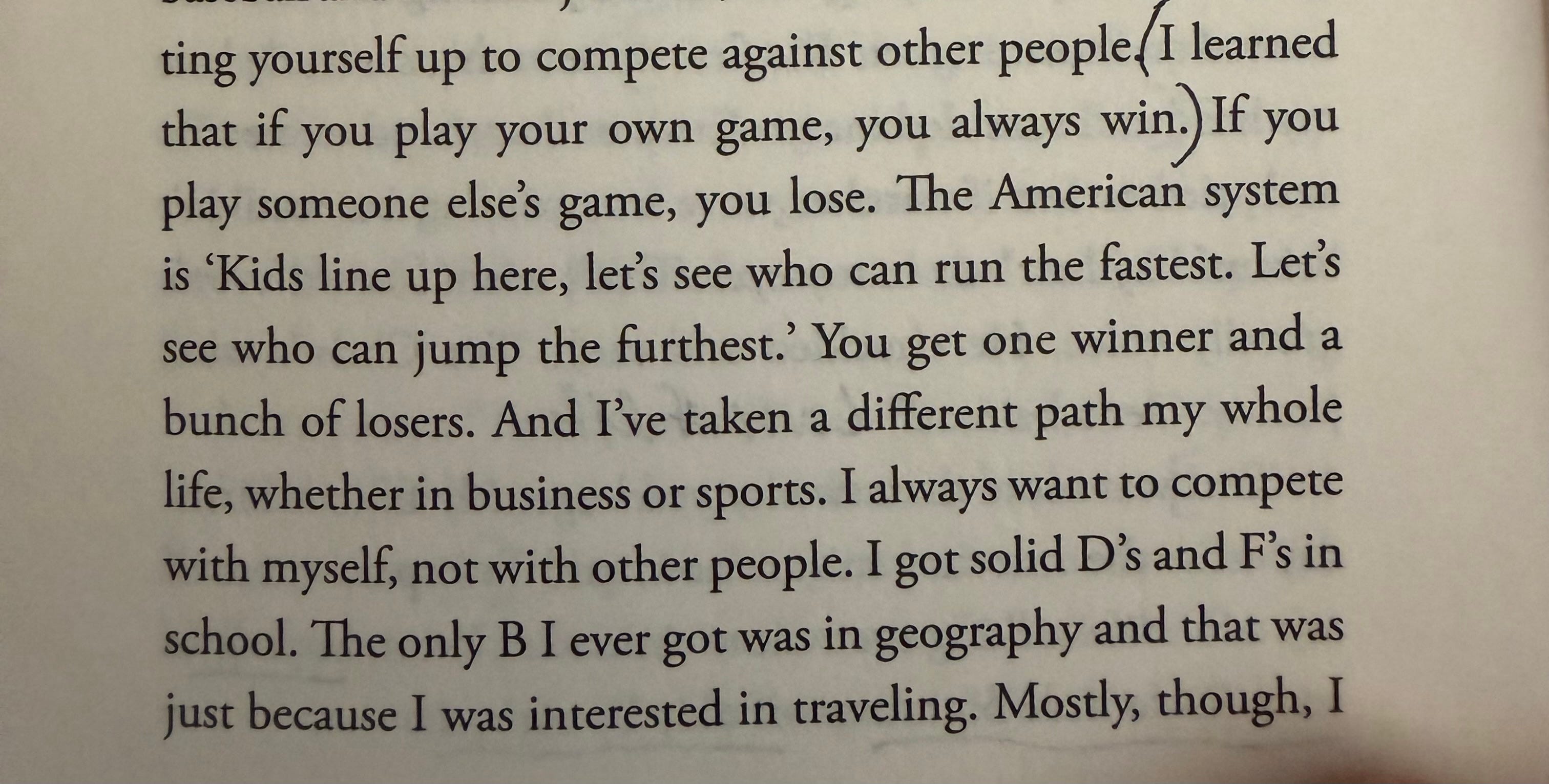
When it comes to our work we don’t seem to have a choice in the matter. We are a literal n-of-1. There is not a single genetic code that is the same as ours, there never will be, and the mere fact that it has come into existence at all is a bewildering miracle. And so if that is true (it obviously is) then your work is yours, and yours alone.
Often the rub is that this fact also implies action, and action means you go out into the world on your own two feet and do something about it. We go out into the world and act because there is something to learn there, and we’re hoping that by learning it we will somehow be changed for the better. We often don’t change - at least not nearly as much as we think - but we do have the chance at change. Discovering something that changes our perspective, or enhances it. That’s what place, people, and work does.
If we are a miracle, the question Kevin Kelly would ask is - how will the miracle happen today?
“I don’t know where we’re going, but I know exactly how to get there.” - Renias Mhlongo
The Local Starbucks & Comella Caffe
In recent years I’ve had a stubborn streak that I’ve been working hard to get over. It started when I came home from a few years of interspersed travel and (whether I like to admit it or not) had a sincere case of reverse culture shock. I didn’t believe that was a real thing before I left - mostly because I was male and in my 20s, so I didn’t believe most things I was told. But it is real, I had it, and it took a set of tools to overcome.

I didn’t have those tools at the time so I spent several years judging everything and every one around me - especially in my home region. I had a bad case of the Returners Flu primarily because I had come from a long stint in a place that was warm, social, religious, and very physically affectionate, and my home was becoming not those things (although it once was - more on this later). In Africa, for example, even my male brethren would reliably put their arm around my shoulder to lazily walk the streets, and the cafe/bar scene was used as an intensely social setting, not as a place to go and read or click-clack on the keyboard.
When I came back I felt like I had none of that, and it felt hollow, vacant, and lonely. I also come from a cold climate, which doesn’t help the social environment at all. instead of strolling down to the cafe or food stall in the evening, encountering your community spontaneously, you’re making dinner at home and so you have to be much more intentionally social. This point is actually very underrated in how the built and social environments intersect - just ask immigrants who move from a warm, outdoor culture, to a cold, indoor culture. It ain’t easy.
Over time though I realized that I needed to leave home to truly know my own, and that to be of a people and place - neither of which you chose - is actually beautiful, and it is for the good to know it, accept it, work on it, and love it. I felt this acutely when Eugene Levi travelled to his ancestral home in the Scottish highlands, to fish, walk, learn about his family history and, eventually, to cry in a small church. I doubt he’d be able to tell you why he was crying, but it has something to do with knowing your roots and your roots knowing you. A homecoming is exactly what is required after being away.
Of the places and the people I judged more harshly than almost any, it was the dreaded commercial chain store, be it McDonald’s, the shopping mall, or Starbucks. I hesitate to admit that I still to this day can’t help but judge them negatively, but I am sincerely working on it, and my friend and I are working on a long-term walking project that includes, in my Canadian context, Tim Hortons.
I loathed these places when I came back. I hated them. What’s wrong with you people?! You’re sitting in an air conditioned, soulless building, eating slop, becoming slop, before oozing back into your Honda Civic to drive off to whatever non-descript office tower you work in. Can you imagine the health of a person who has that in their heart? I’m ashamed to admit it, but that’s where I was, and that's how I know I’ve grown because seeing the world that way is childish and selfish.
Over time, as I grew up and got over myself, I realized I had missed the point of these places entirely. Yes - they are meant to pump as many cheap calories into you as they possibly can (and that can’t be good for your health) but they are also incredibly functional in a way that most places aren’t, and we know that because real people, on an average day, in an average place, use them. It’s as simple as that.
If it’s where the locals go, it’s clearly functional in a way other places are not, or aren’t yet, because they don’t understand the culture they’re serving and how the built and social world are changing in the Birthrate and Borders era.
Read this Chris Arnade post - a dispatch from Australia - if you want to feel this acutely.

When my wife and I recently arrived in Toronto, with the understanding we’d be here for about a month, my first order of business was to find my walks and to find my local. For me that’s the AM version - I’m one for the cafe, not the pub - but I can easily see how both can, and should, quickly become a true local.


Unfortunately for me we were in the suburbs and the proper cafe scene (see - still kind of judgemental) opens much later in the suburbs than it does in the city. In the towns that surround Toronto proper, it first appeared to me like it was damn near 9:00am before “anything good” opened, whereas downtown, it’s 6:30am - a proper time for the awnings to come out!
For me “good” here means a classic cafe that is in the heart of whatever place I’m in. Or at least in one of the main arteries because part of the goal of cafe life is to embed yourself fully in the community you’re in, and to try to understand it a bit better than you could otherwise.
To my utter dismay, by morning two it was clear to me that on Main Street, Unionville, that’s…the Starbucks. I begrudgingly went, suffered through the burnt espresso, tried to find everything and anything wrong with the place, only to find exactly what was right with the place.
The corporate suits behind the business had clearly thought intentionally about what the built environment of the place ought to be like, and I have to admit the dark green and low light fit Unionville perfectly. The baristas were clearly locals (all Asian), were absolutely delightful, and the place was filled to the brim by 8:00 in the morning. It was not filled with tourists, like Unionville is in the evenings, it was filled with locals, who were either there as a part of a group, students studying, remote workers working, families with strollers on the patio, or a group of old lads being lads and pulling up folding chairs outside that they had brought with them.
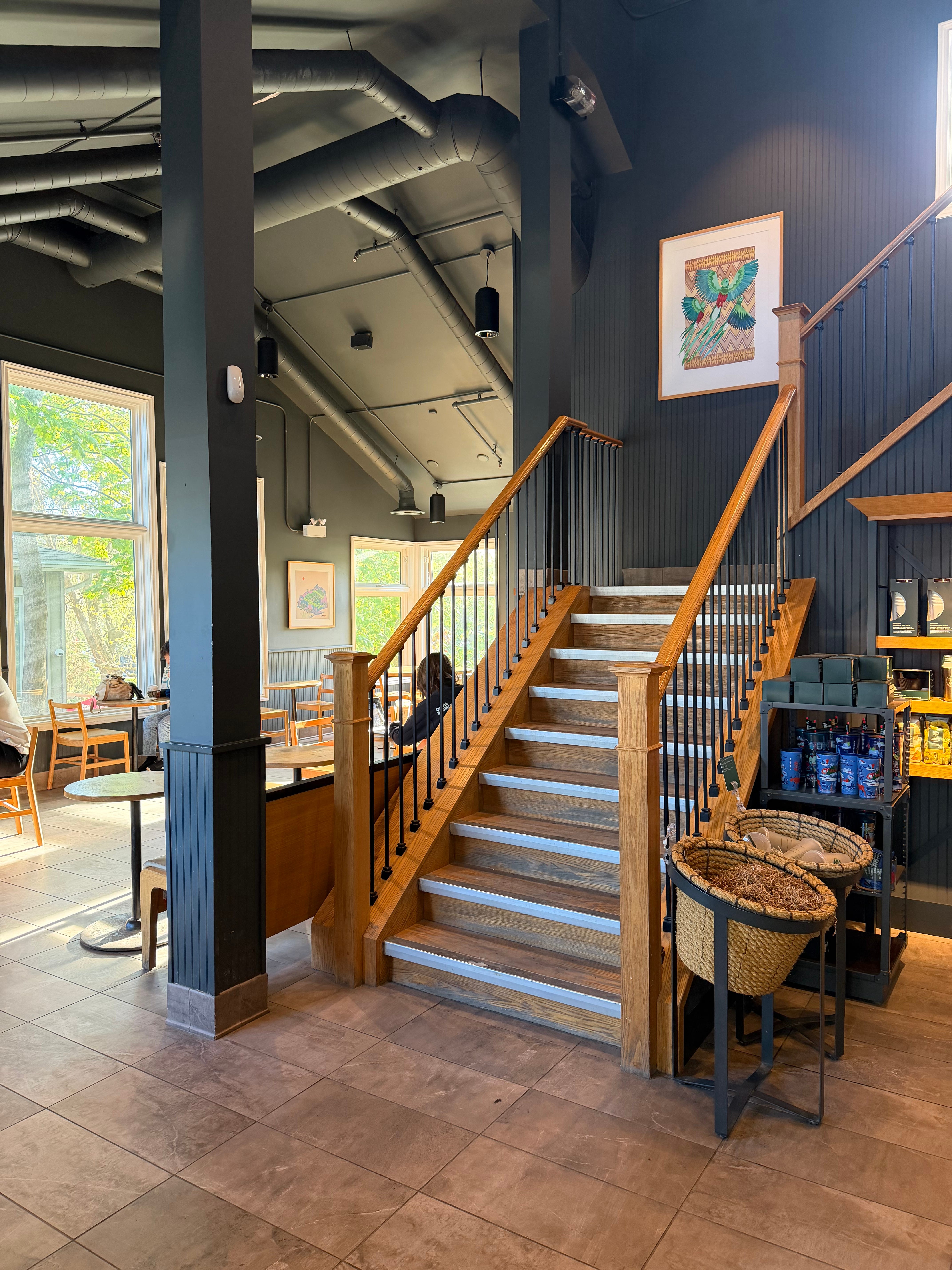
I wanted to hate the place (the coffee really is not good is it?), but came to love it in its way because of how functional, inviting, and used it was. As someone from away, who doesn’t have to choose where to go every morning to be in the community, how could I possibly think anything other than positive thoughts about a place that very clearly serves the local people, where they are, in their place? Do I wish that wasn’t the case? Yeah, I do. I’m not going to hide that. But is it the case? No. We are where we are in our communal history, and for Unionville, that means the Main Street Starbucks.
Alas, as much as I understood this logically, I knew it would never be for me, and so as of morning three or four, I took to the streets to find something that was closer to what I wanted - and boy did I find it.
I found a place that opened at 7:00am each day that it is clearly underrated in every sense of the word. Comella Caffe is tucked into a delightful, independent, Italian grocer - The Garden Basket. It was started by that guy in the cover photo, Jack Comella, who bought the original company from his Uncle, and who to this day comes in early to examine the quality and quantity of hanging flower baskets, say a quick hello to the morning staff and his son Not-Paul1 who runs the deli, and to sit at his table at the back of the cafe where he would work through his paper files. Sometimes a manager or two would come back to greet him and they would talk in Italian-accented-detail about shipping, orders, sales, or something of the like. I even saw Jack and Not-Paul arguing in a nearby isle about what they could do to move more jars of olives2.
Comella is the kind of place that only locals come, because only locals know about it. The kind of place where you have to walk to the back, through the stainless swing doors to use the washroom - a door that is very clearly marked ‘Employees Only.’ The kind of place you immediately feel like you shouldn’t be because it’s where they accept delivery trucks, unload at the loading bay, and where you might get hit by the bread cart on its way to the bakery. It’s tremendous.


I’ve since come every morning, at the open, to have my espresso (excellent), carbonated water (San Benedetto), and to read and write before the day begins. The lesson for me here is that it’s fine to want classic, small, and so local it feels exclusive - I want it constantly and am damn near plagued by it. But that isn’t always where to look if what you want is to embed yourself in the town as it actually is.
Forget the spot that is hot on Instagram - find the obscure gelato shop. Especially if you see round standing tables because that means you will see Italians of all ages standing, sipping, chatting, and then leaving. This is the equivalent of going to the Korean joint and seeing only Koreans inside. If this happens to you, don’t think twice about what you saw on a blog, or on social media - go inside, ask them what’s good, order it, and you can thank me later.
Comella Caffe was the great anchor of my Toronto town travel, and I was happy to call it my local. Follow them on social media, and don’t miss the chance if you’re nearby.
Salut!
—
All we need is a point of view, a set of tools, and a lot of time.
See you on the road.
See you down the road.
-MG
From listening to the local chatter we deduced that there are 3 sons, one named Paul, one who runs the Deli business who is not Paul, and one other. If we solve this mystery I will report back.
I happily bought two so they thought their scheme worked. “SEE! THEY’RE MOVING LIKE HOTCAKES!”